
A SMART Training Platform Webinar presents
Cities That Shape Their Own Climate:
The Hidden Role of Urban Form and Vertical Design in Compact Cities
The SMART Training Platform was excited to have Dr. Varuni Jayasooriya from University of Saskatchewan, to talk about how the physical structure of cities, from urban fabric at the city scale to high-rise building forms, creates distinctive microclimates that impact thermal comfort, energy demand, and environmental resilience.
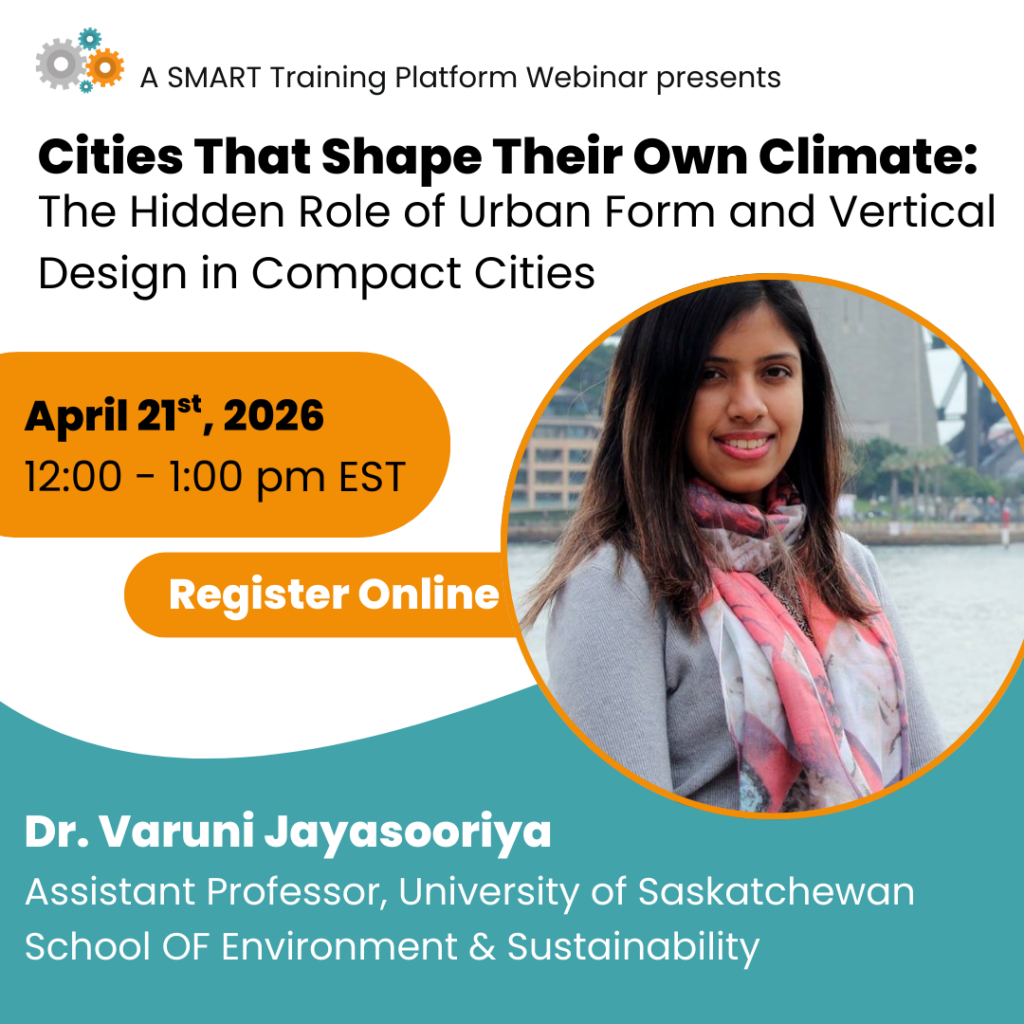
When? April 21st, 2026 12:00 pm – 1:00 pm EST
The webinar will virtual be hosted on Zoom.
About the talk
Cities are increasingly recognized as environments that influence their own local climate conditions. The design of buildings, street canyons, surface materials, and the overall layout of urban spaces affects how heat, wind, and solar radiation move through city environments. This talk explores how the physical structure of cities, from urban fabric at the city scale to high-rise building forms, creates distinctive microclimates that impact thermal comfort, energy demand, and environmental resilience. Using research that combines remote sensing, spatial analysis, computational fluid dynamics, and wind tunnel experiments, the presentation shows how factors such as rooftop materials, surface colors, building density, and vertical architecture contribute to localized temperature variations within dense urban areas. By integrating perspectives from urban planning, architecture, and urban climate science, the talk emphasizes how microclimate-sensitive design can help develop cities that are more thermally comfortable, energy-efficient, and resilient in a warming world.
About Dr. Jayasooriya
Dr. Varuni Jayasooriya is an environmental engineer-in-training and currently serves as an Assistant Professor at the University of Saskatchewan’s School of Environment and Sustainability, where her work centers on advancing urban resilience and climate-adaptive design. With a PhD from Victoria University, Australia, and experience across institutions including the University of Toronto, Canada, and the University of Sri Jayewardenepura, Sri Lanka, she specializes in computational modelling of urban systems. Her research integrates spatial data science and biometeorology to optimize urban microclimates and support NetZero emission goals. Recognized as a 2021 Young Woman Engineer of the Year finalist by the Institution of Engineering and Technology (IET), Dr. Jayasooriya leads multiple international research initiatives focused on climate-sensitive urban design and computational sustainability.